Pages

Showing posts with label Material. Show all posts

9.05.2014

조선의 가구


조선의 가구 VS 북유럽 가구
 어느 때보다 북유럽 가구가 대세를 이루고 있습니다.
사용자를 배려하면서도 친환경적이어서 심플하면서도 감성적인 공간을 추구하는 현대인의 취향과 잘 어울리기 때문인데요.
조선시대에 한국 목가구는 순박한 디자인에 자연과 조화를 이루려는 심성이 더해져
중국이나 일본 등과 구분되는 한국만의 독창적인 가구 양식을 만들어냈습니다.
두 가구 모두 주변 사물과 잘 어울리면서 탁월한 존재감을 갖고 있다는 공통점이 있습니다.
조선 가구와 북유럽 가구가 탄생한 배경과 그에 담긴 철학, 미적 표현방식을 살펴볼까요?
​
​
(좌)평안도 숭숭이 반닫이(사진 제공: 고도사)
(우)Side board(비투프로젝트 소장|340만원|1960년대 제작)
​
​
​

자연과 삶의 철학이 녹아 있는 북유럽 가구북유럽 가구의 특징은 따뜻함과 우아함으로, 재료와 형태를 자연에서 차용했기 때문인데요.
혹독한 자연환경을 극복하기 위해 나무와 패브릭, 동물의 털이나 가죽 등의 천연재료를 
사용해 편안하고 따뜻한 느낌으로 가구들을 배치했습니다.
북유럽에서는 나무가 다른 자원에 비해 풍부한 편인데 특히 스웨덴과 핀란드의 자작나무와 소나무, 
덴마크산 너도밤나무로 제작한 의자와 테이블, 캐비닛 등이 현대 북유럽 스타일의 가구들을 대표하고 있습니다.​
​
(좌)Rosewood desk(빈트 소장 | 가격 미정 | 1958년 제작)
(우)Diplomat chair(비투프로젝트 소장 | 350만원 | 1960년대 제작)
​
​
​
​
현대가구의 전형을 이루게 된 북유럽 가구
북유럽 가구는 현대가구사의 흐름에 두 가지 큰 영향을 끼치게 됩니다.
첫째, 현대가구의 표본을 탄생시켰다는 점입니다. 
대표적인 디자이너로는 덴마크의 카레 클린트(Kaare Klint) 와 한스 베그너(Hans J. Wegner) 등이 있습니다.
이들은 재료가 가진 성질을 충분히 활용해 전통을 재해석하는 모습을 보여
시대를 초월한 독창적인 아름다운 가구를 창조했습니다.
둘째, 합판 곡목기술을 통해‘우아한 기능주의’의 시대를 열었다는 점입니다. 
핀란드의 건축가 알바 알토(Alvar Aalto)는 합판 곡목기술로 북유럽의 자연을 우아한 곡선으로 형상화하여 기능주의에 접목시켰고,
이러한 알바 알토의 성공은 높은 수준의 가구를 일반인들도 누릴 수 있게 해 준 중요한 전환점입니다.​
​
​ (좌)와이 체어
중국의 명나라 의자에서 영감을 받아 디자인 한 한스 베그너의 와이 체어.(사진 제공: Dansk Møbelkunst Gallery)
(우)넘버 포티투
너도밤나무와 자작나무 합판을 곡목하여 만든 알바 알토의 캔틸레버 의자.(사진 제공: Jacksons)

​
​
​
소박한 대중의 삶이 묻어나는 조선 목가구
조선 목가구는 일상용품들을 주제로 다루며 서민의 생활정서를 반영하고 있습니다.
산맥이 가로막은 관계로 주변에서 구하기 쉽고 여러모로 옹골찬 성질을 지닌 소나무로 목조주택을 짓게 되었는데요.
겨울을 나기 위한 방편으로 구들을 깔아 만든 온돌로 인해 낮은 벽면과 창호로 만들어진 여백이 나오게 되었고
평좌식이라는 생활문화를 낳게 됩니다.
서양과 달리 우리나라는 벽면에는 낮고 아담한 규모의 장이나 농, 사방탁자, 문갑 등을 배치하여 옷이나 책 등을 보관하고
서안, 연상, 소반 등을 온기가 모이는 방 한가운데 배치해 이동성을 좋게 만들었습니다.
무늬가 좋은 판재를 2~3mm 가량 얇게 켠 후 수축팽창이 적은 잘 마른 오동나무나 소나무 판재를 뒤쪽에 엇갈려 붙인 얇은 부판을 만들고 기둥과 쇠목, 동자 등 힘을 받는 골재에 끼워놓기 위해 쥐벽칸, 머름칸의 면분할 방법을 창안했습니다.
​
​
삼층장
골재는 단단한 나무를 사용하고 복판재는 부판기법으로
 제작한 먹감나무 판재를 대칭시켜 마치 추상화를 보는 듯하다.
둥근 놋쇠장석을 짜임새 있게 구성하여 화사함을 강조했다.
(사진 제공: 고도사)
​
​​
​
​
조선목가구의 독자적인 조형양식 - 사방탁자와 소반
전통 목가구의 생명은 못을 사용하지 않고 나무와 나무만을 결합하는 짜맞춤에 있습니다.
이 결합방법은 수십 가지가 존재하며 목수의 아이디어에 따라 얼마든지 더 다양하게 응용할 수 있는데요.
조선 목가구가 단순하면서도 튼튼하고 아름다운 이유입니다. 
이러한 짜맞춤의 결정체가 사방탁자입니다.
조선시대의 유교사상은 생활공간을 안방과 사랑방으로 철저히 분리해 사랑방의 주인인 선비들은
자신들의 철학을 가구에 담아 절제비와 비례미가 응축된 사방탁자를 탄생시키게 됩니다.
​
​
사방탁자
여백의 미를 살린 사방탁자는 조선 목가구의 독창적인 양식
이며 소장품의 배치에 따라 또 다른 예술품으로 완성된다.
하단을 풍혈로 장식했다.
(사진 제공: 본태박물관)

​
​

20세기에는 의자가 서양가구의 아이콘이라면 조선시대에는 단연 소반입니다.
좌식 문화에 뿌리를 둔 가구로서 중국의 영향을 거의 받지 않은 고유한 문화유산입니다.
의자도 그러하겠지만 소반 역시 서민부터 상류층에 이르기까지 다양한 계층의 삶의 애환과 역사가 담겨있습니다.
그 모든 디자인이 본연의 역할에 충실하게 되어 있어 ‘작은 건축’이라 불리기도 합니다.
​
​(좌)나주반(사진 제공: 국립중앙박물관)
(우)흑칠 원반(사진 제공: 본태박물관)
​
​
​

생활정서에 바탕을 둔 미감
조선 목가구가 갖는 차별적인 특징은 한국의 생활정서에 바탕을 둔 미감이라 할 수 있습니다.
예를 들면 자연목의 뒤틀림 방지 구조로부터 출발한 쥐벽칸, 머름칸 등의 분할이 보여주는 독창적 비례미,
다양한 금구장식에서 표현되는 길상사상 등은 한국인의 정서를 잘 담아내고 있는데요.
한국 전통가옥의 구조 및 기능과 미를 갖춘 조선 목가구는 세계시장에서 경쟁력을 갖추는데 손색이 없는 요소를 가지고 있습니다.
문화적인 고유성을 살리는 가운데 시대요구를 수용하여 재창작해낸다면
 북유럽 가구 못지 않는 한국 가구의 세계화도 가능하지 않을까요?
​
(좌) 떡살(사진 제공: 고도사)
(우) 이층농(사진 제공: 고도사)


http://blog.naver.com/woodplanet/220112288061


10.29.2013

Mushroom Plastics

‘Mushroom Plastics’ initiative Ecovative wins 2013 Buckminster Fuller Challenge
Posted: Tuesday, October 22, 2013 | discuss
In the past few weeks, the Buckminster Fuller Institute has been introducing numerous finalist entries for the sixth annual Buckminster Fuller Challenge, showcasing the finest examples of socially-responsible design.
Today now, the BFI announced the overall challenge winner: Ecovative, a Green Island, NY-based materials science company that has developed a new class of home-compostable bio-plastics based on living organisms, mushroom mycelia — a high-performing, environmentally responsible alternative to traditional plastic materials.
The 'mushroom material' inventors, Eben Bayer, Gavin McIntyre, and the Ecovative Team, will be awarded the $100,000 cash prize at a ceremony at Cooper Union in New York City on November 18, 2013.

Motherboard TV: UPGRADE: MUSHROOM PLASTICS
Examples of Ecovative's engineered 'mushroom material'.
Click above image to view slideshow
Examples of Ecovative's engineered 'mushroom material'.
The review team and jury found that the Ecovative initiative best exemplified Buckminster Fuller's famous quote: "To change something, build a new model that makes the existing model obsolete."
"We answered the Buckminster Fuller Challenge because we believe in the power of our people to make a real, positive impact. Today, Ecovative looks forward to further answering Bucky's challenge, as we continue to innovate mycological biomaterials and reach an ideal state, with social and environmental considered equally with economics," said Ecovative co-founder and Chief Scientist, Gavin McIntyre.
Ecovative promo composite
Click above image to view slideshow
Ecovative promo composite
Here's an excerpt from the full statement from the Buckminster Fuller Challenge review team and the 2013 jury:
"Maintaining or restoring the quality of water, air, soils and oceans is a fundamental challenge as human populations and resource appetites crest. Efficient use of resources is vital, but insufficient. Basic needs will continue to require growing volumes of materials -- for everything from tabletops to shoes, baby bottles to Band-Aids. Current production methods, however, have left us with a literal sea of troubles. Both the developed and developing world’s ecosystems and human communities are overwhelmingly feeling the effects of rapid resource extraction and growing waste streams tainted with hazardous and long-lasting pollutants. Current regulatory systems largely ignore the long-term implications of exposure to toxic substances and large flows of plastic and other synthetic waste."
Custom molded protective packaging made from Ecovative's 'mushroom material'
Click above image to view slideshow
Custom molded protective packaging made from Ecovative's 'mushroom material'
"Current regulatory systems ignore the long-term implications of exposure to toxicity, unpredictable waste streams, environmental degradation and natural resource depletion that these materials cause, and while life-cycle and ecosystem services analyses are gaining traction, for the most part, the negative impact of these products is not given the attention it deserves.
Finding new models for manufacturing that don't diminish, and can actually restore, Earth's natural resources is an urgent priority. Ecovative, a six-year-old socially responsible materials business and initiative, has disrupted the materials industry with an innovative and cost-competitive natural alternative to petrochemical based plastics and other hazardous materials widely used daily across the world.
Their ‘mushroom material’, grown from living organisms, can be used in everything from protective packaging and furniture to insulation, footwear, even surfboards (and soon some electric car components). Ecovative’s vision is to become the first industrial age company with a net positive impact on the planet’s ecosystem, and they are well on their way. This means eliminating the negative environmental impacts of production associated with the plastics industry, producing a material that sequesters carbon, and delivers nutrients back to Earth."

Ecovative's Mushroom Tiny House
"Their approach, from inception to production, is an extraordinary example of the core tenets of The Buckminster Fuller Challenge’s entry criteria, which require the winning solution to be comprehensive, anticipatory, ecologically responsible, feasible, replicable, and verifiable.
From the materials science underpinning their work to the commitment to rewrite the rules regarding the structure and financing of a startup company, Ecovative is a ground-breaking enterprise."
Wall insulation made from Ecovative's 'mushroom material'
Click above image to view slideshow
Wall insulation made from Ecovative's 'mushroom material'
"Highlights of the comprehensive approach:
  • A closed loop production system using nature’s principles: The supply chain for the mushroom material was developed from the ground up, providing an alternative income source to farmers and other industries through the purchase of organic “waste” materials used as feedstock to grow fungal mycelia into any desired shape. Waste streams utilized for this have included, but are not limited to, agricultural waste, cellulose sludge from paper waste, lobster shells and even textile waste—all sourced within 500 miles of manufacturing. The end product is entirely natural, renewable, home compostable, having a net-positive impact while being high performing and highly cost-competitive. 
  • A model for the 21st century social enterprise: Ecovative has used creative methods to ensure long-term success. [By patenting their technology, they allow access to ideas and technology while avoiding technological compromise and market ‘greenwashing’. With their creative commons licensing, the technology is accessible to everyone, not just in an industrial facility but also in a home kitchen or field. Adhering to strict principles about how they raise their capital, they are avoiding the speculation and short-term gain interests common among “exit strategy” oriented investors, instead attracting long-term and ‘patient capital’ investors. Ecovative has pursued a “mycelial” strategy of partnering with—rather than attempting to compete with—packaging industry giants, becoming an influential force on a new era of green materials."
Wall panels made from Ecovative's 'mushroom material'
Click above image to view slideshow
Wall panels made from Ecovative's 'mushroom material'
  • "This is not just a Styrofoam substitute: Ecovative is already directing resources to research and development, and through scholarships, supports the next generation of socially responsible designers. They continue to develop new uses, such as growing materials to use in inexpensive housing. In one initiative, in Bolivia, the organization is developing ways to use domestic waste streams as a feedstock -- with significant implications for the developing world. 
  • An entrepreneurial success that springs from education innovation: Founders Eben Bayer and Gavin McIntyre developed the core ideas underpinning their products and production methods while studying at Rensselaer Polytechnic Institute, where teacher and mentor Burt Swersey challenged his students to develop marketable, innovative and profitable products that could at the same time improve the world.
The Buckminster Fuller Institute’s review team together with the 2013 jury are very pleased to award the sixth annual Buckminster Fuller Challenge $100,000 prize to Ecovative. This breakthrough solution now joins a stellar group of previous Challenge winners—truly exceptional strategies making the world work for 100% of humanity!"

To learn more about Ecovative and its innovative products and applications, click here.
All images and videos courtesy of Ecovative.

7.19.2013

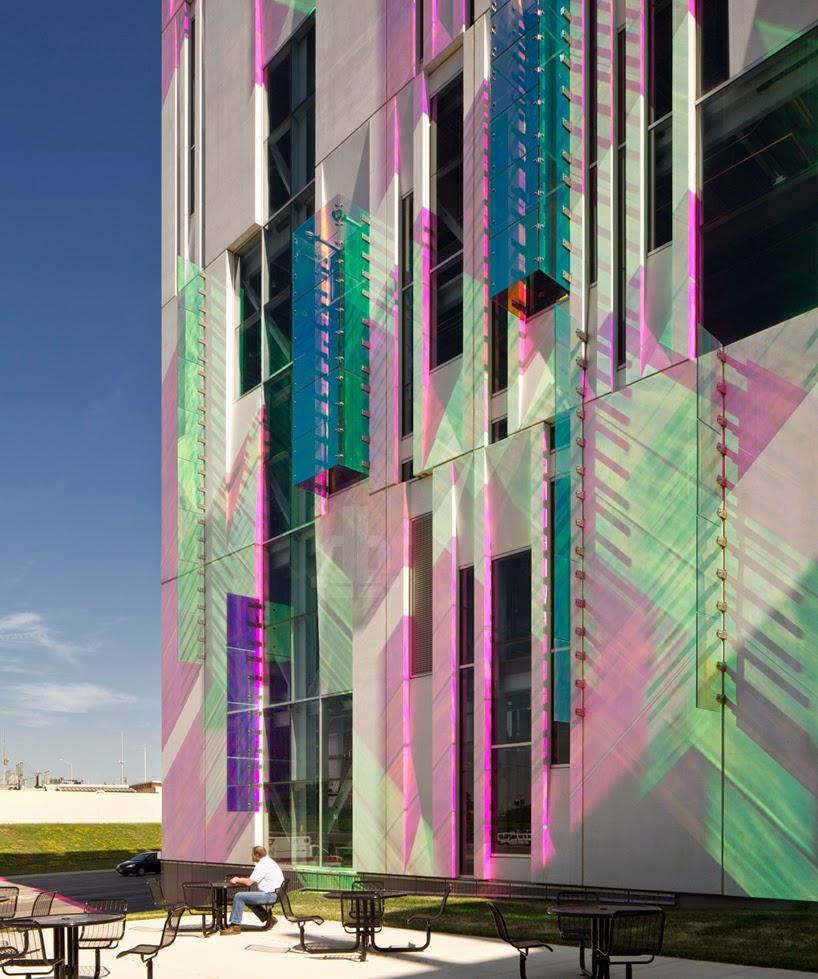
dichoric glass fins


dichoric glass fins, will convey a sense of motion as the colors change from the movement of the sun